
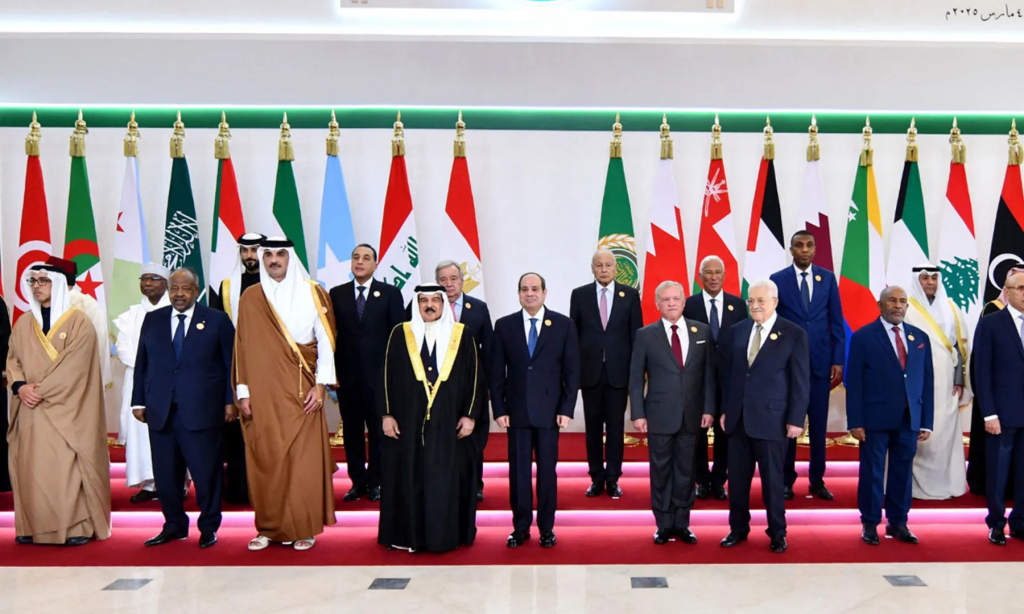
CAIRO—Arab kings and presidents gathered at the Cairo Summit on March 4, 2025, not merely to address the Palestinian cause, but to reinforce the legitimacy of their own rule. While the world was told this meeting was about Gaza, in reality, it was about securing their positions while ensuring they remained in line with Washington’s expectations.
The summit announced a $53 billion reconstruction plan for Gaza, an Egyptian-led initiative that supposedly aims to allow Palestinians to remain on their land without the threat of displacement. This stands in contrast to former U.S. President Donald Trump’s “Middle East Riviera” vision, a plan that many fear would see Palestinians forcibly removed to make way for development projects. Yet, the White House was quick to dismiss the Arab proposal, stating it failed to address “Gaza’s reality.” In other words, Washington is not interested in any plan that does not align with its own agenda—one that includes excluding Hamas from governance and ensuring Israel’s absolute security.
Empty Declarations, No Action
As expected, the summit produced the usual statements—support for a Palestinian state along the June 4, 1967 borders, with East Jerusalem as its capital. A call was made for the United Nations Security Council to deploy international peacekeeping forces in Gaza and the West Bank. But these statements, repeated countless times in past summits, remain nothing more than hollow rhetoric.
The reality? While Gaza burns, while its people face starvation and daily massacres, the Arab rulers do nothing. Not a single step was taken to halt the killing. Not a single action was proposed to challenge Israeli aggression. Instead, their role remains the same: to serve as mediators, to pacify the resistance, and to ensure that no real opposition to Israel’s plans emerges.
A Summit to Serve Washington’s Interests
The real purpose of the Cairo Summit was not to defend the Palestinian people, but to devise an alternative to Trump’s plan—one that still fits within Washington’s conditions. Arab rulers have accepted that direct confrontation with Israel and the U.S. is off the table. Instead, they seek approval from the White House to implement a version of the plan that ensures Israel’s security, eliminates Hamas, and stabilizes the Palestinian Authority—an entity they hope will act as a loyal enforcer, suppressing any real resistance in Gaza and the West Bank.
This was followed by the Jeddah Summit of the Organization of Islamic Cooperation (OIC), which reaffirmed the Arab plan to “rebuild” Gaza. The OIC echoed the same tired slogans—support for Palestinian self-determination, calls for a state along the 1967 borders, and demands for the right of return. But as always, these statements were made with no intention of challenging Israeli and American objectives.
America’s Approval is What Matters
U.S. envoy Steve Witkoff acknowledged the Cairo Summit as a “good-faith first step” from Egypt but refused to endorse its resolutions, referring to them as mere “proposals.” And that is exactly how Washington sees them—suggestions from obedient rulers waiting for approval. The Arab leaders know this; they convene not to resist American hegemony, but to ensure their place within it.
Betrayal in Broad Daylight
Once again, the leaders of the Arab and Muslim world have gathered, only to call for “peace,” “stability,” and “negotiations”—not for the liberation of Palestine, but for its continued subjugation. Their role is to pressure Hamas and the resistance to disarm, to leave Gaza and the West Bank vulnerable like easy prey.
The truth is undeniable: Israel and the U.S. are no longer satisfied with mere recognition and normalization. They seek to permanently alter the reality on the ground—expelling the people of Gaza and parts of the West Bank, transforming Palestinian lands into luxury resorts and economic projects. The Arab rulers, whether kings or presidents, Arab or non-Arab, remain in servitude to Washington. Their betrayal is evident, and the Palestinian people continue to pay the price.
Written by Ridwan Abu Huthaifa
 CrossBorders.Press
Leave a comment