
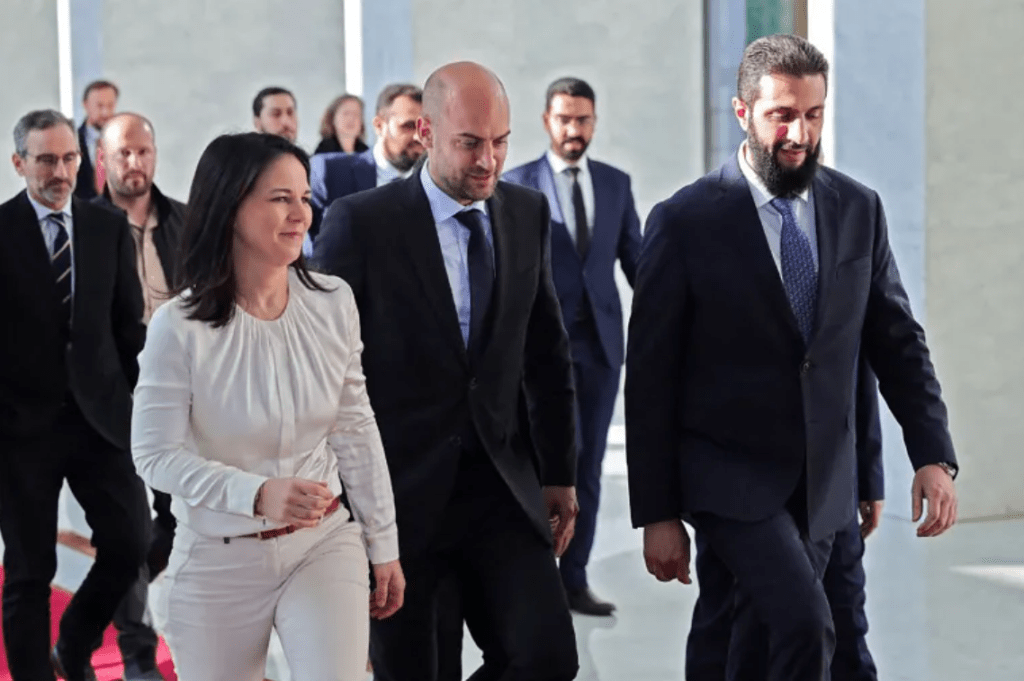
Thirteen years have passed since France and Germany severed diplomatic ties with Bashar al-Assad’s regime, a response to the brutal suppression of the popular uprising that erupted in Syria in 2011. Now, as the dust settles on years of turmoil, these two European powers are extending a hand to Syria, signalling a desire to turn the page and engage with the nation’s future leadership.
The question of Syria’s governance looms large, and Western nations are once again positioning themselves as architects of its political and legal framework. In recent statements, French Foreign Minister Jean-Noël Barrot and his German counterpart Annalena Baerbock offered their nations’ expertise in shaping Syria’s constitution. France pledged legal and technical assistance, while Germany issued a stern caution against any attempts to “Islamise” the judiciary or education systems. At its core, their message seems to be this: any form of Islam in governance is off-limits.’ These moves underline a deeper question for the Islamic world: will it chart its path guided by Islamic principles and its own historical identity, or remain bound to the Western frameworks and systems that many argue have failed it.
At the heart of this debate lies the constitution itself—a document that is not just legal scaffolding but the very soul of a nation. For Muslims, the choice is profound: embrace a system rooted in the Islamic creed and divine guidance, or adopt a secular framework inspired by Western ideals. This debate is not new. Since the fall of the Ottoman Empire, the Muslim world has faced relentless pressure to conform to Western political models, a dynamic that has intensified in the 21st century.
The memory of Syria’s uprising is still raw, and its slogans echo in the hearts of many. In 2011, the chant “Islamiya Islamiya Thowratna Islamiya – إسلامية إسلامية ثورتنا إسلامية” (“Islamic, Islamic, our revolution is Islamic”) captured the aspirations of a people yearning for an identity firmly anchored in Islam. For these revolutionaries, anything less than an Islamic framework would be seen as a betrayal of the sacrifices made during their struggle. The push for secular constitutions is viewed by many as a deliberate attempt to erode the Muslim world’s identity, reducing it to a mere shadow of Western ideals.

This crossroads is more than just a political choice—it is a defining moment for the future of Syria and the broader Islamic world. The decision will determine whether the sacrifices of past revolutions were in vain or whether they will culminate in a state that embodies Islamic principles, honours the aspirations of the Syrian people, and stands as a beacon for Muslims globally. In an increasingly fractured world, the path Syria chooses could reshape the narrative for generations to come.
Written by Rizwan Abu Huthaifa
X: RizAbuHuthaifa
 CrossBorders.Press
Leave a comment