
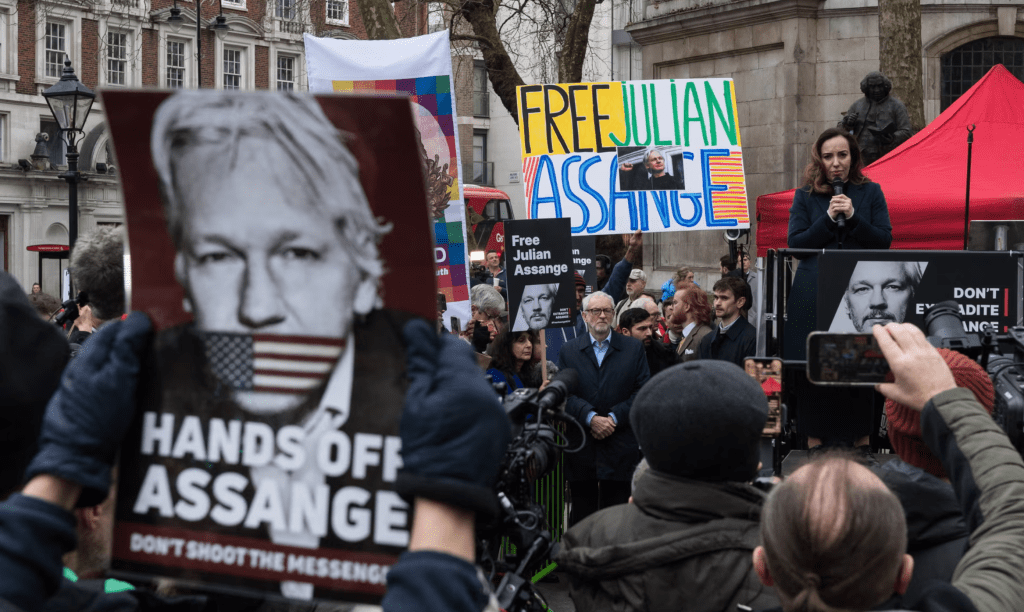
In a dramatic embodiment of the delicate balance between state secrecy and public transparency, the Julian Assange saga continues to unfold in the UK’s legal system. Australian-born computer programmer and WikiLeaks founder Julian Assange remains at the center of a contentious legal battle, illustrating the lengths to which nations will go to safeguard their secrets and uphold national interests.
In the heart of London’s legal district, the High Court hosts the final appeal against Assange’s extradition to the United States, where he faces espionage charges. This case, drawing global attention, encapsulates a complex clash between national security and the sanctity of journalism.
WikiLeaks, under Assange’s stewardship since 2006, has been instrumental in disclosing a vast array of classified U.S. documents, including the Afghan and Iraq war logs and numerous diplomatic cables. These releases have shone an unyielding light on the internal operations of U.S. military and diplomatic endeavours.
Assange’s pivotal moment came in 2010 with the dissemination of classified U.S. military footage depicting a 2007 Apache helicopter attack in Baghdad. This act, among others, cemented Assange as a divisive figure, advocating for public awareness against the backdrop of national security concerns.
The U.S. government’s response was swift and severe, perceiving the leaks as a stark breach of national security. The aggressive pursuit of Assange on various charges, including espionage, underscores a clear message: the U.S. is unwavering in its commitment to protecting national secrets and its geopolitical strategies.
The potential extradition of Assange carries profound personal implications and raises critical questions about press freedom and journalism’s role in democratic societies.
This pursuit of Assange represents more than a legal endeavour; it symbolises a nation-state defending its digital borders. The ramifications of this case reach beyond legal arguments, probing into the moral and ethical dimensions of national security, public interest, and information access.
In Britain, Assange’s extradition case is viewed through the lenses of international law, human rights, and national sovereignty. The British judiciary’s approach not only mirrors the country’s legal principles but also its intricate relationship with the U.S. and stance on press freedoms.
Support for Assange has come from entities like Reporters Without Borders and the National Union of Journalists. His legal team has branded his prosecution as “unprecedented”. However, Clair Dobbin KC, representing the opposing side, contends that the charges are non-political, arising from actions far beyond those of a typical journalist.
In court, Dobbin argued, “His prosecution is founded on legal principles and concrete evidence. Assange’s actions, including his involvement with Chelsea Manning in obtaining and leaking classified materials, are unparalleled.”
Dobbin stressed that Assange’s actions were not limited to publishing information; he actively engaged in illicit activities to obtain classified data. Furthermore, Assange is accused of endangering individuals by indiscriminately revealing the identities of informants to the United States.
“The fundamental facts distinguish Assange’s case from that of the New York Times and other media entities. It’s this factual basis that justifies his prosecution, not his political beliefs,” Dobbin added.

The outcome of Assange’s case is keenly awaited by journalists and publishers worldwide, potentially setting a precedent for how whistleblowers and truth-tellers are treated. This case epitomises the fragile equilibrium between state security and the public’s right to information.
As this saga unfolds, it underscores the selective application of free speech principles, highlighting a systemic flaw where freedom of speech is upheld selectively, often aligning with the interests of certain nations or individuals. This stark reality serves as a reminder that the principle of free speech is not universally applied, often functioning more as a mechanism for power than a universal right.
W.R.
 CrossBorders.Press
Leave a comment